
What pruning a fruit tree is for
Three things: taking out wood that's dead, diseased or damaged, opening the middle so light and air get in, and keeping the fruit low enough to pick.
Olives New Zealand describes the same idea for commercial groves: opening the canopy so airflow and sunlight help with disease management and ripening. Fungal diseases such as peacock spot are the biggest challenge its growers name, and a crowded crown is where fungus does well.
Pruning from the ground, in order
Clean, sharp hand tools
Secateurs, loppers and a pruning saw. Wipe the blades between trees so you don't spread disease. Keep both feet on the ground: if you can't reach a branch from there, leave it.
Dead, diseased and damaged first
Cut back to healthy wood or the branch it grows from, and bag diseased cuttings.
Then crossing and crowded growth
Where two branches rub, keep the better placed one. Thin out the shoots growing straight up through the middle (water shoots).
Suckers at the base
Take off shoots from the roots or below the graft, the knobbly join low on most fruit tree trunks.
Stop while it still looks like a tree
Take a little each year, not a lot at once. Cutting back to stubs (topping or lopping) brings a flush of weak shoots and fewer fruiting branches.
When should I prune?
It depends on the tree and your climate, and we haven't found New Zealand timings we'd stand behind for most fruit. The exception is olives: Olives New Zealand says commercial trees are usually pruned in spring, and the harvest typically runs from mid-March to mid-July. For apples, pears, stone fruit and citrus, ask a local arborist or nursery about your variety.
When it's an arborist job
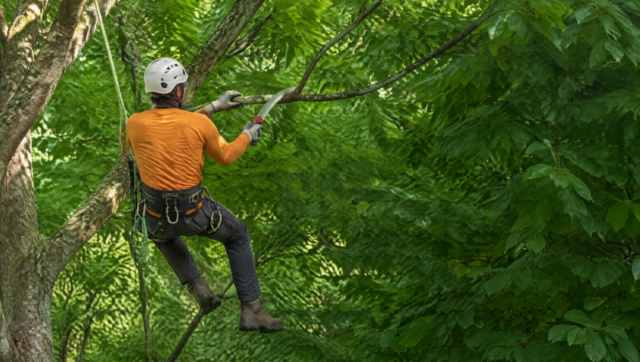
When you'd have to leave the ground. Tall trees, and anything over a fence, roof or path, need someone with the gear to work at height. Edible figs can reach 10 m, NZPCN says. See our fig tree guide.
When the cuts are big. A limb thicker than your wrist, or a neglected tree, is worth having done properly.
When there's a power line. Only approved utility arborists may trim a tree with any part within 4 m of a network line. The service line to your house is yours to manage, but don't prune near it yourself.
When the tree might be protected. On a listed tree, even light pruning can be controlled: Dunedin's 2015 proposals needed consent to prune a scheduled tree with anything beyond hand-operated pruning shears or secateurs. Check tree removal consents first.
Tree pruning: what you can do yourself
You can
- Prune dead, diseased and crossing branches you can reach from the ground.
- Remove suckers and water shoots.
- Thin crowded fruit by hand so branches don't overload.
- Rake up and bag fallen diseased fruit and leaves.
Leave to an arborist
- Anything you can't reach with both feet on the ground.
- Big limbs and reshaping cuts.
- Bringing an old or neglected tree back over a few seasons.
- Any tree near a power line.
Hiring an arborist for tree pruning
We'd do the small, regular cuts ourselves every year and get an arborist in every few years for the big ones. A tree pruned lightly and often stays lower and healthier than one rescued after years of neglect.