
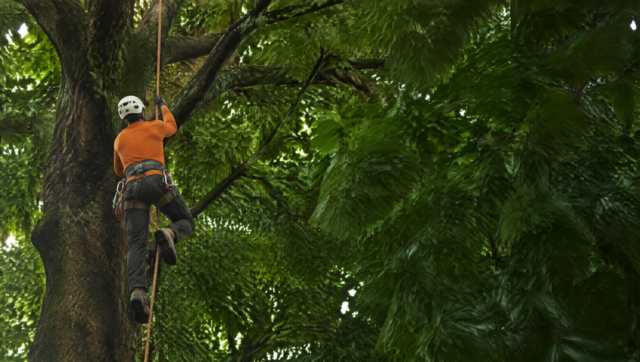
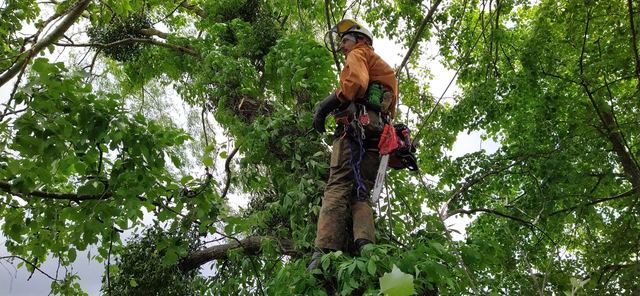
Lopping is just the word plenty of people use
Lots of people ask for tree lopping or tree topping when they mean any kind of trimming, and that's fine. An arborist will know what you're after.
The word only matters when it describes the cut itself: sawing straight across branches, or across the leader (the main upright stem), at whatever height looks right, and leaving stubs. That's the job most arborists will try to talk you out of, kindly, and offer something else.
Topping and pruning, side by side
| Topping or lopping | Pruning | |
|---|---|---|
| Where the cut goes | Straight across a branch or the trunk, wherever the height is wanted | Back to a side branch, a junction or the trunk |
| What grows back | A cluster of fast, upright shoots from just below each stub | Mostly ordinary growth from the branches that are left |
| How the new growth holds on | Weakly, from the outer layers of wood near the cut | Like any normal branch |
| The wounds | Big, flat stubs that decay can move into | Smaller cuts at a junction, which the tree is better at sealing off |
| How long it lasts | Often back to size within a few seasons, and denser than before | Longer, because the tree's own shape still works |
| How it looks | Bare stubs, then a broom of regrowth | The same tree, smaller or lighter |
Why topping causes trouble later
A tree's leaves are its food factory. Taking most of the crown off in one go leaves it short of energy just when it needs to grow over a lot of big wounds, and a stressed tree is more open to pests and disease.
The stubs themselves often die back, and decay can travel down from them into the branch or trunk. Meanwhile the tree pushes out a mass of new shoots near each cut. Those shoots grow fast but are only shallowly attached, so as they get heavy they can tear out, especially in wind.
The result is a tree that's often bigger, denser and more likely to drop branches a few years later than it was before, and one that needs cutting again and again. None of that means the tree has to stay big. It means making it smaller takes a different kind of cut.
What to ask for instead
- Crown reduction: an arborist shortens the longest branches back to side branches big enough to take over, so the outline shrinks but the shape stays natural.
- Crown thinning: selected branches come out from inside the canopy so light and wind pass through, which can ease shade and wind load.
- Crown lifting: the lowest limbs are removed to clear a roof, a path, a driveway or a view.
- Deadwooding: dead branches are taken out before they fall.
- Replacement: if a tree is simply wrong for its spot, a removal and a better-suited tree can beat years of hard cutting.
Protected trees come with pruning limits
Councils that list trees often set limits on how they're pruned. In Auckland, permitted trimming of a notable tree can't cut a branch over 50mm across or remove more than 10 per cent of live growth in a calendar year, and has to keep the tree's natural shape, form and branch habit. Trimming outside that standard needs resource consent.
Christchurch's District Plan lets a works arborist remove top-third foliage from a significant tree only within tight limits: no more than 10 per cent over any three-year period, and no more than five per cent in any one year. Topping a listed tree would fall well outside rules like these.
So check with the council before any heavy pruning. Our tree rules by council page and notable trees guide help you find out whether yours is listed.
Near power lines or off the ground, stop
If any part of the tree is within 4 m of a network power line, leave it alone: Vector, for one, says only qualified and approved utility arborists may trim there, and your lines company is the call to make. Don't prune from a ladder, and don't take on any branch you can't reach with both feet on the ground. That's arborist work.
Briefing an arborist on a tree that's too big
Say what the problem is
Too much shade, branches over the roof, a blocked view, or worry that it'll fall. Each has a different fix.
Ask which cut they'd use
If the answer is cutting it back to stubs at a set height, ask whether a reduction or thinning would do the job instead.
Ask how much will come off
And how soon it's likely to need doing again.
Check whether it's listed
For a notable or protected tree, the council has a say in how much can be cut.
Get the method in the quote
Our guide to reading a tree quote shows what a pruning line should say.
What you can prune yourself
You can
- Small branches you can reach with both feet on the ground.
- Cuts with secateurs, loppers or a pruning saw, made back to a junction without leaving a stub.
- Dead twigs, and suckers shooting from the base.
- Clearing small growth off a path or a window.
Leave to an arborist
- Anything needing a ladder, a climb or a chainsaw.
- Reducing a tree's height or spread.
- Big branches over the roof, the fence line or a neighbour's section.
- Notable and protected trees, and anything near power lines.
Tree topping, lopping and pruning: what to do next
If a tree had got too big, we'd ask an arborist for a reduction back to side branches, and accept that getting it to the right size might take more than one visit. If even that wouldn't solve the problem, we'd think about replacing it with something that suits the spot, rather than topping it and starting a cycle of regrowth.
Want an arborist to look at it?
Tell us the job and your postcode, and a local arborist calls you to talk it through.