
Which palm have you got?
Nīkau (Rhopalostylis sapida) is New Zealand's own palm. NZPCN says it grows to 15 m with a ringed trunk, and its fronds reach 3 m long with leaflets up to 1 m.
Canary Island date palm (Phoenix canariensis) is the broad, heavy-crowned palm of older gardens and parks. NZPCN lists it as an environmental weed, one of 386 on a 2024 DOC list.
Bangalow palm (Archontophoenix cunninghamiana) is a slender exotic palm, naturalised here since 1992 and also listed as an environmental weed (2024).
Being on DOC's weed list is about the plant spreading into the wild. It isn't a legal order to remove it, and it doesn't switch off the council rules.
What a palm trim involves
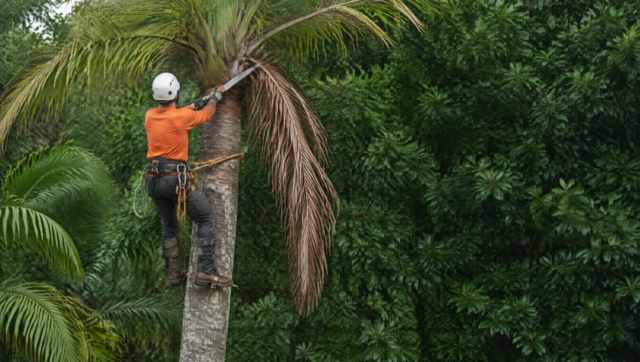
A trim usually takes off the dead and dying fronds, the flower and seed stalks, and loose old frond bases. Leave the green fronds on: the palm feeds through them, and stripping the crown back hard weakens it.
Big fronds are heavy and awkward at height, and some palms carry sharp spines near the base of each frond, so a tall palm is a job for an arborist with the right gear. Near a power line, only qualified and approved utility arborists may work on trees within 4 m of a network line.
Removing a palm
An arborist takes a palm down from the top in sections, usually by climbing or from an elevating work platform, and lowers each piece rather than dropping it near the house.
A single-trunk palm can't regrow once the trunk is cut, because it grows from one tip at the top. What's left is the stump and a dense, fibrous root ball, which a stump grinder or digger deals with. See stump grinding.
With a bangalow, the job isn't over when the palm goes. NZPCN says its seed is spread by birds, gravity and people, and its long-lived seed bank means years of follow-up weeding.
Can a palm be protected?
Yes, like any other tree. In Auckland's urban zones, removing any indigenous tree over 3 m tall within 20 m of mean high water springs needs resource consent, which can catch a coastal nīkau. Christchurch says consent is likely for removing a council tree of a listed species such as nīkau palm. Check tree removal consents before any palm comes out.
Palm tree removal: what you can do yourself
You can
- Pull palm seedlings by hand while they're small.
- Rake up fallen fronds and bag seed from weedy palms.
- Cut low dead fronds you can reach with both feet on the ground, wearing gloves.
- Check the district plan before any removal.
Leave to an arborist
- Anything above head height on a tall palm.
- Removing a palm in sections from the top.
- Any palm within 4 m of a network line (approved utility arborists only).
- Grinding or digging out the stump and root ball.
Hiring an arborist for palm trees
For a Canary or bangalow palm you've never loved, we'd check the plan, then have it out rather than trim it every year, and pull seedlings for a while after. For a nīkau, we'd check the plan and keep it if we possibly could.