
Locate pipes and cables before anyone digs or grinds
Water pipes, drains, power and fibre often run close to old trees. beforeUdig is an online service that collects plans of cables, pipes and other utility assets around a dig site from the people who own them, and it names homeowners among those who should use it. Plans generally arrive within two business days, and beforeUdig says not to start until they do. Some asset owners, including Unison, Centralines, Eastland Network and Kāpiti Coast District Council, aren't members, so contact them directly if you're in their area. If your spade hits a pipe, a cable or concrete, stop there.
Grind, dig or leave: which suits your stump?
| Grind it | Dig it out | Leave it | |
|---|---|---|---|
| Best for | Most tree stumps, and anything with thick roots | Shrubs and young trees whose stump already rocks a little | Corners you won't mow, build on or plant |
| Who does it | An arborist or a stump grinding operator | You, with a spade, loppers and a pruning saw | Fungi, insects and weather, slowly |
| Ground disturbed | Mostly the stump and its surface roots | A wide hole around the root ball | None |
| What to watch | Buried services, and chips flying off the wheel | Your back, and anything buried | Tripping, fungi, and regrowth on some species |
Option one: have it ground out
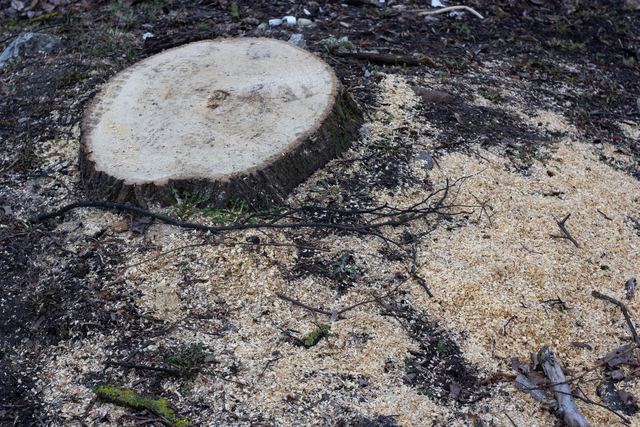
Grinding is the usual answer for anything bigger than a shrub. WorkSafe's 2012 arboriculture code describes a stump grinder as portable machinery that reduces or removes a stump by grinding it. The wheel works down through the stump and the big surface roots and leaves a hole of chips and soil. Deeper roots stay behind and break down over time.
Running a grinder isn't homeowner work, and we don't give instructions for it. NZ Arb's Best Practice Guide counts stump grinders among an arborist's core competencies, sets out the protective gear operators must wear, and says a running grinder must never be left unattended.
On the day, keep children, pets and cars well back. Before you book, ask how deep the grind will go and what happens to the grindings, and get both written into the quote. Our stump grinding page covers the job in more detail.
Option two: dig out a small stump by hand
Make sure it's small enough
This suits shrub stumps and young trees, the kind that already moves when you push it with your boot. If the roots are too thick for loppers or a pruning saw, it's a grinding job.
Get the services plans
Lodge a beforeUdig enquiry with your dates, the type of work and the address, and wait for the plans. Anything a past owner laid, like irrigation or a cable to the shed, won't be on them.
Dig a ring around it
With a spade, dig a trench all the way round the stump until the main roots show. Gloves, sturdy boots and eye protection are worth wearing.
Cut the roots you uncover
Cut each exposed root with loppers or a pruning saw, keeping the blade well clear of your feet. Work round until the stump rocks freely.
Lift it out and fill the hole
Rock the stump loose and lift with your legs, with a second person for anything heavy. Backfill with soil, firm it down, and top it up over the following weeks as it settles.
Option three: leave it to rot
Leaving a stump is the least work and the slowest result. A low stump can be planted around or hidden under groundcover while it breaks down.
The trade-offs are a trip hazard in the lawn, fungi fruiting on the wood as it rots, and new shoots on species that resprout. Macrocarpa isn't one of those: the NZ Farm Forestry Association says it doesn't regrow from a cut stump, though its roots are slow to decay.
If you're weighing up a stump-killing product, read its label and follow it to the letter. We don't give chemical advice on this site.
Before you start: whose stump is it, and what's nearby?
A stump on the berm or in a reserve sits with the council's trees. Hamilton City Council, for one, says street and park trees shouldn't be pruned or removed without its permission, so ask the council before touching a berm stump anywhere.
WorkSafe's 2012 code names stump removal as work that has to be notified to the appropriate authority when it may affect underground gas, water, electricity, telecommunications or wastewater services. NZ Arb's guide adds that below-ground work can need the network owner's approval.
Think about the roots of trees that are staying. In Auckland, the notable tree rules cover a listed tree's protected root zone as well as the tree, and work in that zone not otherwise provided for needs resource consent. If the stump is close to a listed tree, yours or the neighbour's, check with the council first. Our notable trees guide explains listings.
Kauri need extra care. Since 2 August 2023, earthworks inside a kauri hygiene zone, three times the radius of the canopy dripline, have needed an earthworks risk management plan. Nothing we've read settles whether grinding or digging out a stump counts as earthworks, so ask the arborist and Tiakina Kauri before any work near a kauri.
If a storm brought the tree down, talk to your insurer before booking the stump work. The Insurance Council says house cover doesn't extend to removing the part of a tree that's still in the ground. Our storm guide covers the rest.
What you can do, and what to hand over
You can
- Lodge a beforeUdig enquiry and wait for the plans before any digging.
- Dig out small shrub stumps with a spade, loppers and a pruning saw.
- Mark sprinklers, drains and garden lighting you know about.
- Snip new shoots off a stump as they appear.
- Fill and level the hole after grinding, and reuse clean chips as mulch (kauri material has its own rules).
Leave to an arborist
- Grinding any stump, and digging out anything bigger than a shrub's.
- Stumps beside the house, a drain, a retaining wall or a tree you're keeping.
- Stumps near a notable tree or a kauri, where the rules need checking first.
- Taking the grindings away if you'd rather not keep them.

Removing a tree stump: what to do next
We'd get the services plans first, every time. For anything bigger than a shrub, we'd have it ground, with the depth and the clean-up written into the quote. We'd dig by hand only where the stump already moves underfoot, and we'd leave one to rot only where nobody mows, walks or builds.
Want an arborist to look at it?
Tell us the job and your postcode, and a local arborist calls you to talk it through.