
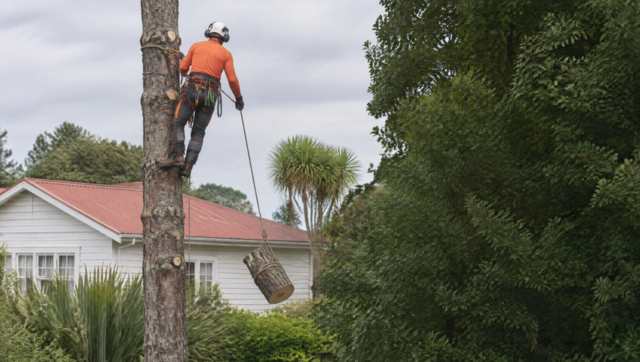
If it could come down soon
Keep people, pets and cars out of the area it could hit, which reaches further than its branches. Don't pull, prop or cut at it. Call 111 if anyone is in danger. If it's touching a power line, don't go near the tree or the line, and if a line is down, stay at least 10 metres away and call 111. Treat every line as live.
Signs a tree may be failing
- Dead branches through the crown, or bark coming away in sheets.
- Decay: soft wood, hollows, or fungi growing at the base or on the trunk.
- A crack or split running into the trunk or a main fork.
- A new lean, or soil lifting or cracking on one side of the base.
- Broken branches hung up in the crown.
- Yellowing leaves or a thinning canopy out of season, or bleeding gum at the base of a kauri (a kauri dieback sign to report).
Why trees fail
Christchurch City Council lists fungi, borers, poor planting and stresses like drought and flooding among the causes of poor tree health. The NZ Farm Forestry Association adds that macrocarpa is prone to toppling on some sites, and radiata pine can get root rot in waterlogged ground.
Does a dead tree still need consent?
It can. Dying doesn't take a tree off a district plan schedule, and plans set their own process for dead and failing trees.
In Christchurch, a dead or structurally failed significant tree needs a Tree Removal Certificate (P-024) submitted before it's felled, prepared by a technician arborist from council's list. In Auckland, removing a notable tree is a discretionary activity that needs resource consent, and taking dead wood out of one is permitted only when a qualified arborist does it. Hamilton says its protected trees cannot be removed, and asks owners to talk to council first.
Ring council before anyone cuts: tree removal consents links each council's page.
What an arborist's assessment gives you
It tells you what's wrong and how much has to go: sometimes the whole tree, often one limb or the deadwood (dead branches still on the tree). For a protected tree, it's the evidence council will want. NZQA's Level 6 Diploma in Arboriculture trains people in tree risk assessment, and Christchurch asks that standard of its technician arborists. See arborist reports.
Dead trees are harder work than live ones. WorkSafe's 2012 code warns that parts can fall into the work area as a dead tree comes down, which is why this is never a weekend job.
Tree removal: what you can do yourself
You can
- Keep people and cars out of reach, and tape the area off.
- Photograph the tree, its base and anything that's fallen, with dates.
- Check the district plan and ring council before booking a removal.
- Tell Tiakina Kauri or your regional council if a kauri looks unhealthy.
Leave to an arborist
- Deciding whether it's dead, dying or just stressed.
- The written assessment, and any council certificate.
- Taking down hanging branches, deadwood or the whole tree.
- Anything near a power line, once the lines company is involved.
Hiring an arborist for tree removal
We'd book the assessment before the removal, and get council's answer in writing before any cutting. If the tree is an immediate danger, call 111 and tell council, but don't skip the process.