
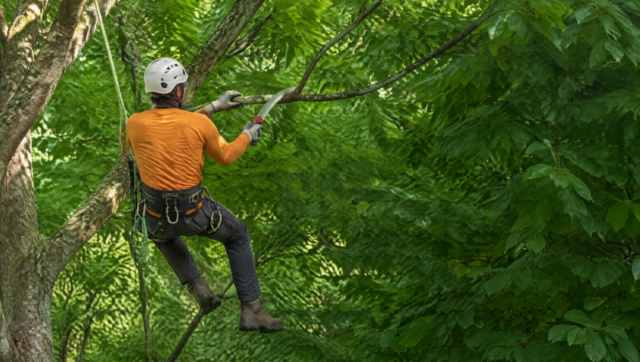
How tree pruning works in Wellington
A dense crown catches wind like a sail. In a city where NIWA counts gusts over 63 km/hr at the airport on 166 days of an average year, that load adds up, and the weak point is usually a heavy limb, a tight fork or a branch reaching out over the roof.
WREMO's storm advice includes trimming trees before bad weather arrives. That doesn't mean a ladder and a saw the night before a warning. It means booking an arborist well ahead, because gales are most frequent in winter and everyone rings at once after the first big one.
Storm damage and fallen trees in Wellington
| Crown thinning or reduction | Topping or lopping | |
|---|---|---|
| What's cut | Selected branches, back to a fork or the branch collar | Every branch cut to a stub at one height |
| In the next gale | Wind passes through a lighter, balanced crown | Dense regrowth catches the wind again |
| The regrowth | Slower, and attached properly | Fast shoots, weakly attached to the stubs |
| A year later | Still looks like the same tree | A bushy top that needs cutting again |
Tree pruning in Wellington: what's local
Ridge-top trees
On exposed hillsides, NIWA notes much of the larger vegetation leans permanently east. A tree like that has grown to suit the wind, so an arborist will be careful about how much comes off the sheltered side.
Lines on your street
Wellington Electricity pays for the first cut or trim of a tree that hasn't had a notice before. Its arborists follow natural target pruning, sometimes with a 'V' cut so the tree grows away from the line, and regrowth shows within six months. A risk tree notice is different: it flags a tree that complies now, and you're not legally obliged to act on it.
Your own service line
Trees around the line from the boundary pole to your house are your responsibility, and the lines company's first trim doesn't cover them. Unless a qualified arborist does the job, have your retailer arrange a temporary disconnection before anyone works near it.
Protected trees
Some trees are protected under the District Plan, and protection can cover pruning, not just removal. Check our Wellington permit page and ask the council before a big prune on an old tree.
Trees and power lines in Wellington
Never touch a power line, or a tree or branch that's touching one. If someone is in danger, call 111. Otherwise ring Wellington Electricity. If you, the tree or any tool could come within 4 metres of a network line, leave the job to an authorised arborist.
Tree pruning in Wellington: what you can do yourself
You can
- Cut small branches you can reach with both feet on the ground, using secateurs, loppers or a pruning saw
- Trim hedges and shrubs at head height or below
- Take photos of splits, dead limbs or a worsening lean to show an arborist
Leave to an arborist
- Anything that needs a ladder, a climb or a lift
- Any work within 4 metres of a network power line (an authorised arborist only)
- Crown thinning or reduction on a large tree
- Pruning a tree the District Plan protects, once consent questions are sorted
Questions to ask about tree pruning in Wellington
- How much of the crown will come off, and where will the cuts be made?
- Is the tree protected under the District Plan, and who checks that?
- Is any part of the tree within 4 metres of a line, and are you authorised to work near it?
- Does the written quote cover getting gear up the section and the clean-up?

Hiring an arborist for tree pruning in Wellington
Get a big tree looked at in autumn rather than after the first winter gale. Ask for a reduction or a thin, not a topping, and ask the arborist to show you which limbs they're worried about. If lines are involved, ring Wellington Electricity first, because the first trim may be theirs to pay for.