
Is the belt or section under a power line?
Don't fell or trim anything near a power line yourself. Within 4 m of a network line, only qualified and approved utility arborists may trim trees, so find your lines company on the Electricity Networks Aotearoa map and call them first. The service line from the network to your house is yours to look after: get an arborist's advice on that one.
When is it a clearing job?
When you're after the ground, not one tree: clearing a section for a new house, opening up an overgrown back half, or taking out a row of old macrocarpa on a lifestyle block. Past the trees come the brush, the stumps, the roots under the future slab, and the rules for that land.
Macrocarpa and pine shelter belts
Many old shelter belts are macrocarpa or radiata pine. The NZ Farm Forestry Association says macrocarpa has been widely planted here for shelter and timber, and can reach 40 metres high and 2 to 3 metres in diameter.
Both can turn from shelter into a hazard. Macrocarpa is prone to toppling on some sites, and some strains get canker, a fungal disease that kills branches and leaders (the top shoots). Fast-grown radiata on fertile ground has heavier branches that break more easily, and can have few roots, leaving it open to windthrow (blowing over, roots and all).
Watch the stock, too. Cypresses can cause abortion in pregnant cattle, so the association advises keeping them well back from fence lines where cattle may graze next door.
Macrocarpa doesn't coppice (regrow from the cut stump), but its roots are slow to decay. Radiata seed spreads on the wind, so expect seedlings along the old belt line.
Do you need a consent to clear land?
Often, for part of the job. Clearing rules sit in your district plan and can turn on where trees grow. In Auckland, removing vegetation within 10 m of an urban stream or 20 m of a natural wetland needs consent, and Significant Ecological Areas have rules of their own.
The 2012 change that ended blanket tree protection was about urban sections, so don't assume a rural or lifestyle block works the same way. And as Tauranga City Council notes, a covenant or consent notice on the title can protect trees too.
Start with tree removal consents.
Kauri near the work
Since 2 August 2023, earthworks inside a kauri hygiene zone (three times the radius of the canopy's dripline) have needed an earthworks risk management plan covering how machines, gear and footwear are cleaned. Whether stump grinding counts as earthworks isn't confirmed, so ask Tiakina Kauri and the arborist early. See the kauri dieback guide.
Replanting near lines
From 23 July 2027, in the low height planting zone outside urban areas, you mustn't plant a tree you'd reasonably expect to outgrow its distance from the line. Lines companies can't issue treefall hazard notices before 23 July 2028, so until then their requests to remove trees are voluntary. More in trees near power lines.
How an arborist clears a section
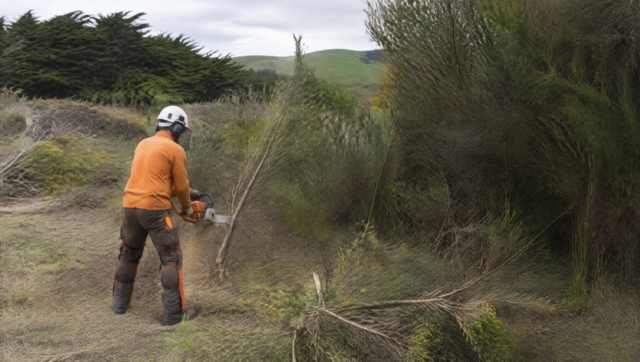
It starts with a walk round and a plan of what stays, with those trees fenced off so machines keep off their roots. Then trees come down, in pieces where there's no room to drop them whole, brush goes through a chipper, and stumps are ground or dug out. See tree removal and stump grinding.
Big belts are often excavator and forestry mulcher work, so mention soft ground or a narrow gateway up front.
What happens to the mulch?
Chips can be spread on beds and around kept trees, stockpiled or carted away, and logs can stay as firewood. Ask how gear is cleaned between sites: myrtle rust spores travel on contaminated equipment, and Tiakina Kauri's line for contractors is arrive clean, stay clean, leave clean.
Keep children well away from a running chipper. NZ Arb's Best Practice Guide says one must never be left unattended.
What the quote should cover
- Which trees go and which stay, marked on a plan you've walked together.
- Who gets any consent or kauri plan, and its conditions.
- Access for trucks and machines, and what's underneath: fences, drains, lines.
- Stumps and roots: ground or dug out, and how deep where you're building.
- Mulch and logs: spread, stockpiled, left or taken away.
- Machine cleaning, public liability insurance and the final clean-up.
Land clearing: what you can do yourself
You can
- Ask council what the plan allows on your section, in writing.
- Read the title and LIM for covenants or consent notices.
- Lodge a beforeUdig enquiry for the dig area, or agree who will.
- Pull small weeds and pine seedlings by hand.
Leave to an arborist
- Felling trees and whole shelter belts.
- Anything close to a network power line (approved utility arborists only).
- Chipping, mulching and heavy machinery.
- Stump grinding and root removal, after services are located.

Hiring an arborist for land clearing
We'd settle the rules before the quotes: council's answer in writing, the title read, a beforeUdig enquiry lodged. Then we'd mark what stays and get every quote against that plan. Under a power line, the lines company gets the first call.