
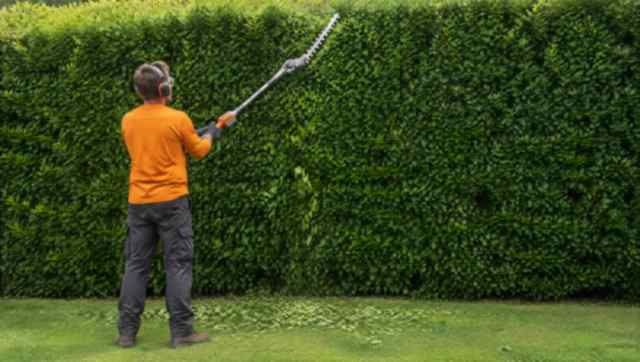
Garden hedge or shelter belt?
A garden hedge is a row of shrubs or small trees kept to a shape: griselinia, pittosporum, privet, photinia, box. Most stay dense with regular light trims that take off the new growth.
A shelter belt is the farm version: a long row of trees planted to break the wind for stock, crops or the house. The NZ Farm Forestry Association says macrocarpa has been widely planted in New Zealand for shelter, and calls radiata pine wind hardy. Left alone, both grow into full-size trees.
What makes a hedge job bigger or smaller?
Height. A hedge you can trim from the ground is quick. Above head height it needs a platform, scaffold or mechanical trimmer, and that changes the job more than anything.
Width. A wide hedge has to be cut from both faces and the top, which can mean working from the neighbour's side or the road verge.
Access. Hedges on a bank, behind a garage or along a steep drive are slow to reach, and a tractor-mounted cutter needs clear ground along a shelter belt.
How hard it's cut. A light trim is routine. Cutting an overgrown hedge back into old wood is a bigger job, and many conifer hedges don't regrow from bare wood, so a hard cut can leave a permanent brown patch.
The clippings. Mulched on site, taken away or left for you. A long hedge produces more green waste than most people expect.
Shelter belts on lifestyle blocks
Old shelter belts are where hedge trimming turns into tree work. The NZ Farm Forestry Association says macrocarpa prefers some shelter and is prone to toppling on some sites, and that fast-grown radiata on fertile ground can have few roots and be subject to windthrow (blowing over, roots and all).
Radiata on fertile sites also grows bigger branches that break more readily. A belt that hasn't been trimmed in years deserves a look from an arborist before a cutter goes along it.
Think about stock as well. The same association warns that cypresses can cause abortion in pregnant cattle and says to keep the trees well back from fence lines where cattle may graze next door. With a cypress belt on the boundary, ask where the trimmings will end up.
If the belt is coming out altogether, that's land and shelter belt clearing, with stump grinding to follow.
Hedges growing into power lines
To a lines company, a hedge is a tree: Orion's guidance says trees include shrubs, hedges and climbing vines. Only qualified and approved utility arborists may trim within 4 m of a network power line, so don't trim a hedge that's grown into the wires yourself. Ring your lines company. The service line from the street to the house is the property owner's responsibility, so get an arborist's advice before anyone trims around that one.
Your neighbour's hedge, or yours on their boundary
Community Law says it's always best to talk to your neighbour first, and a hedge height is far easier to agree on before anyone has cut it.
Community Law also says you can cut back the parts of a neighbour's tree that encroach on your property, as far as the boundary. If talking gets nowhere, the Property Law Act 2007 lets you apply to the District Court for an order that your neighbour trim or remove a tree, and for that purpose a tree includes any shrub or plant, hedges among them.
The judge must find the order fair and reasonable and needed to prevent a listed problem, such as undue obstruction of a view or blocked light spoiling the use of your land, and must weigh your hardship against your neighbour's. Judges are cautious here, and the person applying usually pays for the work. This is general information, not legal advice; our neighbours' trees guide has more.
On the street side, councils can ask owners to cut back hedges over the footpath. Christchurch, for example, says owners must trim trees overhanging boundaries to at least 2.5 metres above the footpath and berm and 5 metres above the road.
What to get in writing before the hedge is cut
- The finished height and width, on both faces and the top
- A light trim or a hard cut back, and what it will look like afterwards
- How they'll reach it: platform, scaffold or mechanical trimmer, and whether they need the neighbour's side
- What happens to the clippings
- Any power line in or near the hedge, and who deals with it
- Public liability insurance
- Whether they'd suggest a regular trim, and how often
Hedge trimming: what you can do yourself
You can
- Trim a low hedge you can reach with both feet on the ground, using hand shears
- Snip out dead or broken stems with secateurs
- Rake up and bag the clippings, and keep them out of gullies and streams
- Agree the height with your neighbour before a boundary hedge is cut
- Ask the council first if the hedge is beside a stream or the coast
Leave to an arborist
- Anything above head height, or needing a ladder, platform or scaffold
- Shelter belts and tall rows of trees on lifestyle blocks
- Hard cut-backs of overgrown hedges
- Hedges within 4 m of a network power line (approved utility arborists only)
- Taking a hedge out, roots and stumps included

Hiring an arborist for hedge trimming
We'd settle the finished height with the neighbour before anyone picks up the shears, because that's the part people argue about later. For a tall hedge or a shelter belt, we'd have an arborist look at it on site rather than describe it over the phone, and get the height and width written into the quote. If a power line runs through it, the lines company comes first.