
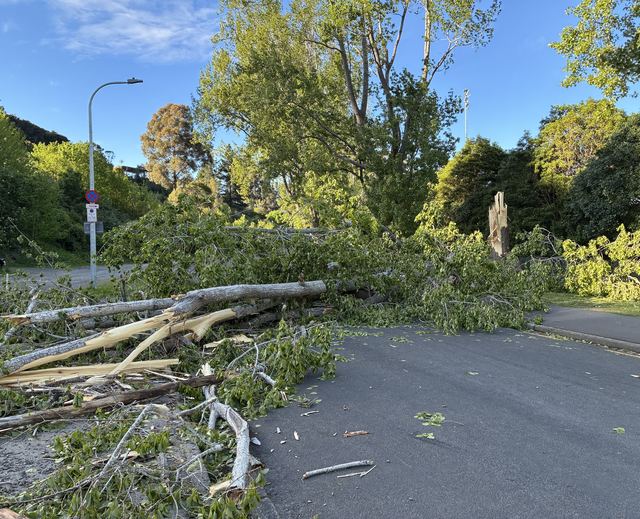
First: is anyone in danger?
Call 111 if there's an immediate threat to life or property. If a power line has come down, keep at least 10 metres back, treat it as live even on the ground, and call 111, then your lines company. Keep everyone out from under hanging or split branches and away from a tree that has shifted at the roots. Don't climb onto the tree or the roof to deal with it, and if you were evacuated, don't go home until you're told it's safe.
What to do, in order
Make it safe from a distance
Keep children, pets and cars away, and block the area off with whatever you have, such as wheelie bins or tape. Don't try to move or cut anything that's under strain: a bent branch or trunk can spring when it's released.
Report lines and council trees
A tree on a line goes to the lines company, and trees and power lines lists the lines companies and the areas they cover. A council tree in the road or a park goes to the council straight away; in Hamilton, ring the council or use the Antenno app.
Take photos before anything moves
The Natural Hazards Commission asks people to take photos only when it's safe, and to photograph damage before repairing, moving or throwing anything away. Get wide shots of the tree and close-ups of what it hit, and keep a written record.
Ring your insurer
Report the damage to your insurer as soon as you can, or to your landlord if you rent. Ask what your policy covers before you book any clean-up.
Check whether the tree is listed
If it's a notable tree in the district plan, dealing with what's left can still need the council. Ask before doing anything more than making it safe.
Get an arborist to look
Once the wind drops, an arborist can make it safe and quote in writing for the rest. WorkSafe's 2012 arboriculture code says tree work must stop while high winds, wet weather or poor visibility make it dangerous, so a short wait can be the safe call.
Who pays? House insurance first
The Insurance Council of New Zealand (ICNZ) says that, in general, the tree itself isn't covered by a house policy. Damage it does to insured structures such as the house, garage or fences generally is, along with removing the parts of the tree that caused that damage. Removing the rest of the tree, still in the ground, isn't covered.
If storm-felled trees didn't damage an insured structure, there's unlikely to be cover for removing them and cleaning up. Some policies have a landscaping or tree removal benefit with limits, so ask your insurer what yours includes.
And the Natural Hazards Commission?
Natural Hazards Commission Toka Tū Ake (NHC), formerly EQC, is a Crown entity providing natural hazards insurance for residential property owners. If your home insurance includes fire insurance, as most policies do, you have natural hazards cover, and in most cases you make the claim through your private insurer.
For storms and floods, NHC cover is land only: the land under the home, the land within 8 metres of it, and the land under the main accessway up to 60 metres away. The home itself is your private insurer's job.
NHC can help with removing fallen trees only from insured land, only up to its cap, and never for work you do yourself. Neither NHC nor house insurance covers the tree itself.
Who usually covers what
| House insurance (ICNZ, in general) | Natural Hazards Commission | |
|---|---|---|
| The tree itself | Generally not covered | Not covered: trees, gardens and lawns aren't included |
| Damage to the house, garage or an insured fence | Generally covered, plus removing the parts of the tree that did it | Not NHC's job: storm cover is for land, and fences aren't included |
| The rest of the tree, still standing | Not covered | Not covered |
| Fallen trees that hit nothing insured | Unlikely to be covered | Can help clear them from insured land, up to its cap |
| Clean-up you do yourself | Ask your insurer | Not paid for |
Whose tree was it?
If a neighbour's tree came down on your place, ICNZ says they're generally not liable unless it's shown they were negligent, for example by ignoring a rotten tree or requests to remove it.
If your tree went through a fence you own jointly with a neighbour, ICNZ says your insurance will likely pay for 50% of the fence. A car hit by a falling tree is covered if you have full car insurance rather than third party cover.
Council trees belong to the council. In Christchurch and Hamilton, for example, nobody else should prune or remove a street or park tree without the council's permission, so report it and let the council deal with it.
Civil Defence and a declared emergency
In a big event, follow your local Civil Defence and council advice, and the emergency services. Stay away from damaged areas until the all-clear is given.
In Auckland, that means official updates from Auckland Emergency Management. In the Wellington Region, WREMO coordinates Civil Defence and emergency management for the nine councils.
A damaged notable tree still needs the council
A storm doesn't take a tree off the schedule. In Auckland, removing a notable tree is a discretionary activity, and even one removed through emergency works only comes off Schedule 10 once council has sighted the approval and given the owners written notice.
Christchurch asks for a Tree Removal Certificate (P-024) before a dead or structurally failed significant tree is felled, and a council-listed technician arborist has to prepare it.
WorkSafe's 2012 code says emergency tree work should be the minimum needed to make the situation safe. So make it safe now, and talk to the council before the rest comes down. Notable trees explains how to check a listing.
What you can do, and what to leave to an arborist
You can
- Keep people, pets and cars well back
- Photograph everything before it's moved
- Call your insurer, or your landlord if you rent
- Rake up small twigs and leaves well away from any line
- Find out whether the tree is listed
Leave to an arborist
- Hanging, split or twisted branches
- A tree on the roof, a car or a fence
- A trunk or root plate that has moved
- Anything touching a line (the lines company first)
- The stump and whatever is left standing

A tree came down in the storm: what to do next
We'd call 111 if anyone was at risk, get everyone well back, and leave the tree alone. Next would come photos and a call to the insurer, before any clean-up is booked. Then we'd ask an arborist to make it safe and quote the rest in writing, checking the council's schedule first if there's any chance the tree is listed.
Want an arborist to look at it?
Tell us the job and your postcode, and a local arborist calls you to talk it through.