
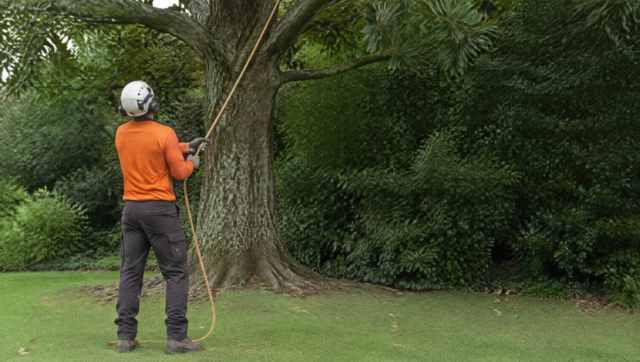
A tree touching a line, or a line down
Never touch a power line, or a tree or branch that's touching one. If a line is down, stay at least 10 metres away from it and call 111. Treat every line as live, even one lying on the ground, and report it to your lines company (the lines companies are listed below). Don't try to pull a branch clear, shake the tree or cut anything near the line yourself.
Street lines and the service line: which is which?
Network lines run along the street and belong to your lines company, the business that runs the local network. The service line connects your property to that network.
The tree rules, the Electricity (Hazards from Trees) Regulations 2003, only cover network lines. Your service line is the property owner's responsibility, and the lines company's first cut doesn't reach it: Aurora Energy says the first trim it pays for excludes private service lines, and Electra's applies only to trees that aren't near one.
A tree growing into a service line is still a job for an arborist, never for a homeowner with loppers. If branches are touching it, keep clear and ring your lines company for advice before anyone goes near it.
The zones around a line
The regulations draw zones around every network line. The growth limit zone is the space that must stay clear of trees. The cut-back zone extends 1 metre beyond it, and the hazard warning notice zone extends 2 metres beyond it.
The growth limit zone depends on the voltage. On Vector's network it's 0.5 m for 230 to 400 V lines, 1.6 m for 6.6 kV and 11 kV lines, and 2.5 m, clear to the sky, for 33 kV lines. Orion says that from 17 October 2026, clear to the sky applies to 33 kV and 66 kV lines in urban areas and to all voltages outside them.
Those zones measure the lines company's work, not a safe distance for you. Only qualified and approved utility arborists may trim within 4 m of a network line, and Vector says owners may trim only when every part of the tree is at least 4 m away.
Got a notice? What to do
Work out which notice it is
A hazard warning notice says a tree is getting too close. A cut or trim notice means the tree must be cut back as the notice requires. Wellington Electricity also sends risk tree notices for trees that risk its network but currently comply, and says owners aren't legally obliged to act on those.
Check the deadline
Timeframes vary, so go by your notice: Orion asks for the work as soon as possible or within 45 days. MainPower's summary of the regulations says a no-interest notice generally has to be given within 10 working days, and a dispensation applied for within five.
Give access
Vector still needs the owner's signature on a cut or trim notice to approve access. WEL Networks lets owners give consent online after a First Cut or Trim Notice.
Leave the cutting to approved contractors
Within 4 m of the line, it's approved utility arborists only. Vector names Treescape, Asplundh and Franklin Trees; Aurora uses Asplundh in Dunedin and Delta in Central Otago, Wānaka and Queenstown Lakes. Vector asks for at least three working days' notice of any trimming owners arrange themselves.
If you disagree
Talk to the lines company first. Unresolved disputes about tree notices can go to Utilities Disputes, the complaints scheme for electricity and gas, or to the government-appointed tree arbitrator.
Who pays: the first cut, then you
If a tree qualifies for its first cut or trim under the regulations, the lines company pays for that work. After that, keeping it clear is generally the owner's responsibility. Ignoring a cut or trim notice can bring a fine, plus more for every day it continues, and Orion points out that an owner is liable if their trees damage the network.
The details differ by company. Wellington Electricity generally does the first cut at its own cost through its contractor Treescape, which clears the debris too. Electra's needs a tree with no earlier Electra-funded trim that isn't near a service line, and the owner has to grant access. Aurora's doesn't cover trees planted after the line went in. Orion applies the first cut per property and says it has already done one on all its lines.
Treefall hazard notices: coming, but not yet
The Electricity (Hazards from Trees) Amendment Regulations 2026 took effect on 23 July 2026, with some changes phased in later. They add a treefall hazard zone, extending 24 metres from the edge of the growth limit zone, though being inside it doesn't automatically make a tree hazardous.
Lines companies can't issue treefall hazard notices before 23 July 2028; until then, any request to remove a tree is voluntary. A notice will need a moderate or high hazard assessment, backed by written advice from a qualified and experienced arborist, and owners can challenge it through arbitration.
From 23 July 2027, in the low height planting zone outside urban areas, you mustn't plant a tree you'd reasonably expect could grow taller than its distance from the line.
Lines companies and the areas they cover
| Area | |
|---|---|
| Top Energy | Far North |
| Northpower | Whangārei and Kaipara |
| Vector | An Auckland lines company (check the map for your street) |
| WEL Networks | Its network across the Waikato |
| Waipa Networks | Waipā |
| The Lines Company | Based in Te Kūiti |
| Powerco | Parts of the North Island, including Tauranga, Coromandel, Taranaki, Whanganui, Manawatū and Wairarapa |
| Unison | Hastings, Napier, Taupō and Rotorua |
| Firstlight Network | Gisborne, Wairoa and the East Coast |
| Electra | Kāpiti Coast and Horowhenua |
| Wellington Electricity | Wellington, the Hutt Valley and Porirua |
| Marlborough Lines | Marlborough |
| Westpower | West Coast of the South Island |
| MainPower | Waimakariri, Hurunui and Kaikōura districts |
| Orion | Central Waitaha Canterbury |
| Network Waitaki | Based in Ōamaru |
| Aurora Energy | Dunedin, Central Otago, Wānaka and Queenstown Lakes |
| PowerNet | Invercargill, Southland, West Otago and parts of Central Otago |
Not sure which one is yours?
It isn't the company you pay your power bill to: that's your retailer. Electricity Networks Aotearoa's lines company map shows the lines company, its phone number and its website for any address. Use it for southern Auckland, Nelson and Tasman, Mid and South Canterbury and the eastern Bay of Plenty, where we couldn't confirm the details.
What you can do, and what isn't yours to do
You can
- Save your lines company's faults number
- Ring the lines company about any tree growing toward a network line
- Read, sign and return a notice, or ask questions about it
- Plant well away from lines, thinking about the tree's full height
Leave to an arborist
- Any work within 4 m of a network line: approved utility arborists only
- Trees growing toward the service line to your house
- Trees that could fall onto a line in a storm

Trees near power lines: what to do next
If a tree's anywhere near a street line, we'd ring the lines company before an arborist and let its approved contractors handle anything within 4 m. We'd read any notice the day it arrives, because the deadlines are short. For the service line to the house, we'd have an arborist look before the branches reach it, and when planting, we'd pick something that stays well short of the wires.
Want an arborist to look at it?
Tell us the job and your postcode, and a local arborist calls you to talk it through.