
How big does macrocarpa get?
Macrocarpa (Cupressus macrocarpa) comes from the Monterey Peninsula in California, and has been planted widely here for shelter and timber. NZPCN describes it as a medium-sized tree to about 36 metres, with a distinctive fluted trunk once mature.
The NZ Farm Forestry Association puts the top end higher: a macrocarpa can grow for over 200 years, reaching 40 metres high and 2 to 3 metres across the trunk.
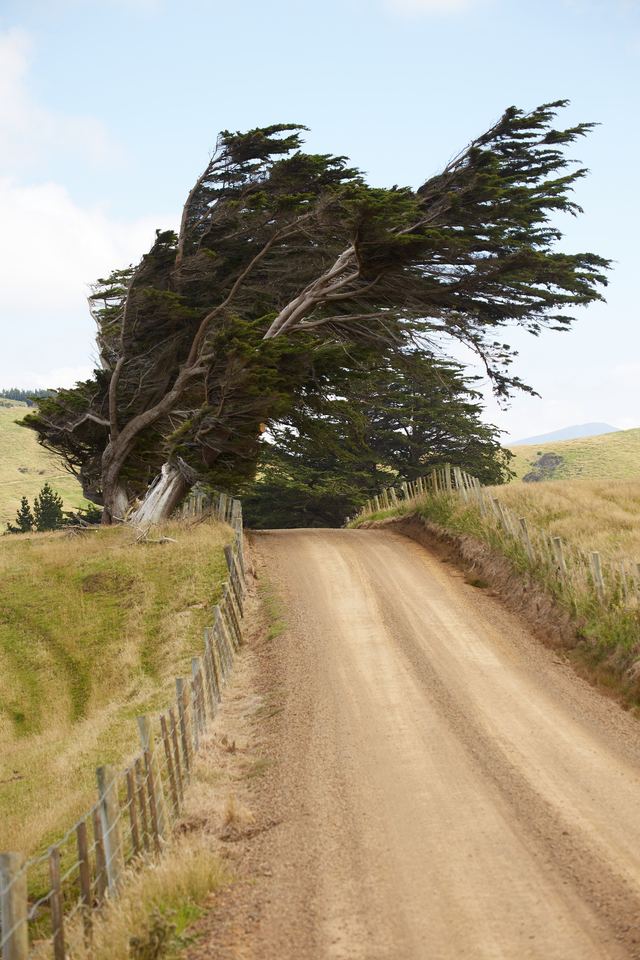
The Farm Forestry Association says it handles drought, frost and salt-laden wind, but prefers some shelter and is prone to toppling on some sites.
Signs an old macrocarpa needs a look
- Browning or dying tops and branches: some strains are susceptible to canker, a fungal disease that can kill branches and leaders.
- A new lean, or soil lifting at the base after a strong wind.
- Gaps where trees in the belt have already come down, leaving the rest more exposed.
- Big limbs hanging over the house, a road, a driveway or the power lines.
Why shelter belts come out
Size is the usual reason: a belt that's outgrown the section shades the house, the garden and the road. Toppling is the next. When a few trees go, the rest lose their neighbours' shelter, which is why it pays to plan the whole belt.
Stock is a real issue on lifestyle blocks. The Farm Forestry Association warns that cypresses can cause abortion in pregnant cattle, so trees should be kept well back from fence lines where cattle may graze next door. Cattle, goats and deer will also strip the bark and kill the trees.
Macrocarpa also spreads. NZPCN records it as naturalised since 1904 and lists it as an environmental weed (2024) that colonises regenerating bush and scrub near planted trees and hedgerows. That's a conservation listing, not a legal status, and it doesn't change the consent rules for your trees.
Power lines, and replanting near them
Only qualified and approved utility arborists may trim trees within 4 m of a network line, so if any part of a belt is close, call your lines company first. Under the 2026 changes to the tree regulations, a new treefall hazard zone reaches 24 metres from the edge of the growth limit zone. Being inside it doesn't automatically make a tree hazardous, and lines companies can't issue treefall hazard notices before 23 July 2028. Our power lines guide explains the notices.
If you're replanting shelter, think about the line too. MainPower says that from 23 July 2027, in the low height planting zone outside urban areas, you must not plant a tree you'd reasonably expect could grow taller than its distance from the line.
Trimming a macrocarpa hedge from the ground
Clipping the face of a low macrocarpa hedge you can reach with both feet on the ground, using hand shears or secateurs, is garden work. Like most conifers, macrocarpa is reluctant to reshoot from old bare wood, so keep your cuts in the green growth or you can leave a gap that won't fill.
Anything taller, a whole belt, or work that needs a ladder or a machine is arborist work: see hedge trimming and shelter belt clearing.
The stumps, and consent
Cut macrocarpa won't sprout from the stump: the Farm Forestry Association says it doesn't coppice. Its roots are slow to decay, though, so if you want to use the ground soon, plan on grinding. Removing a tree stump covers the options.
Before a belt or a big tree comes down, check whether any of it is listed in your council's district plan or sits somewhere the plan protects. In Auckland, for example, removing vegetation within 10 m of an urban stream needs resource consent, whatever the species. Our tree rules by council page is a starting point.
Yours, or the arborist's?
You can
- Hand-clip a low hedge you can reach from the ground, staying in the green.
- Pick up fallen branches and debris after wind.
- Keep cattle, goats and deer away from the trunks.
- Photograph the belt after big storms so you can spot change.
Leave to an arborist
- Felling trees or reducing the height of a belt.
- Trees with dying tops, splits or a new lean.
- Any work close to power lines, through the lines company.
- Grinding stumps and clearing once the trees are down.

Macrocarpa trees and shelter belts: what to do next
We'd have an arborist walk an old macrocarpa belt before deciding anything, looking for canker, lean and lifting roots. If part of it has to go, we'd ask how taking some trees out will expose the rest to wind, and plan the whole belt rather than one gap at a time. And if cattle graze next door, we'd keep the trees well back from that fence.
Want an arborist to look at it?
Tell us the job and your postcode, and a local arborist calls you to talk it through.