
Find the pipes and cables first
Grinding and digging go below ground, so underground services need locating before the work starts. beforeUdig is an online service that gives anyone planning to dig plans of the cables, pipes and other utility assets around the site, and it says not to go ahead until that information arrives. WorkSafe's 2012 arboriculture code also says stump removal that may affect gas, water, electricity, telecommunications or wastewater services must be notified to the right authority. While a grinder runs, keep children and pets well away: chips and stones fly.
Three ways to deal with a stump
| Grind it | Dig it out | Leave it | |
|---|---|---|---|
| What's left | A hole of grindings mixed with soil; the bigger roots stay in the ground | A large hole once the stump and main roots are lifted out | The stump, slowly breaking down |
| Disturbance | Small: one machine and a spray of chips | Large: an excavator and a lot of soil moved | None |
| Suits | Lawns, garden beds and replanting nearby | Building, paving or a new driveway on the spot | Out-of-the-way corners, or a stump you want as a seat or planter |
| Watch for | Services underneath, nearby walls and paths | Services, the fence line and the neighbour's tree roots | Regrowth from some species, and tripping over it |
How does stump grinding work?
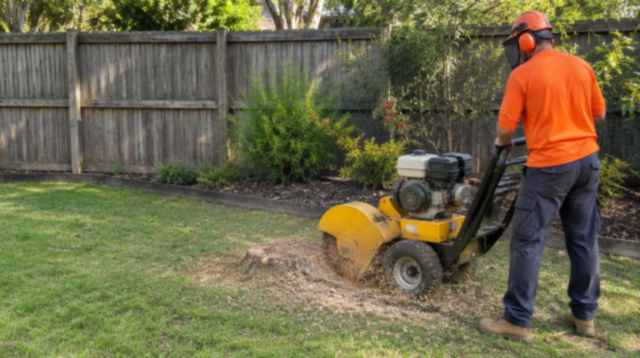
WorkSafe's 2012 code describes a stump grinder as portable machinery that reduces or removes a stump by grinding it. A toothed wheel works back and forth across the stump and down below the surface, turning the wood into chips.
Machines come in sizes, from narrow ones that fit through a garden gate to bigger tracked units for large stumps. Tell the arborist about gates, steps and slopes so a machine that fits turns up.
How deep it goes depends on the machine and on what you want the spot for. If you're laying lawn, planting a new tree or putting in a path, say so up front and ask for the depth in the quote.
It's operator work. NZ Arb's Best Practice Guide lists using stump grinders among an arborist's core competencies, sets out the protective gear operators must wear, and says a running grinder must never be left unattended.
Who finds the services, and what can be missed?
beforeUdig says homeowners should use it as well as contractors, so agree with the arborist who lodges the enquiry. Plans come from each asset owner and generally arrive within two business days, and a new enquiry is needed if they expire or the job changes.
It isn't complete. Some asset owners, including Unison, Centralines, Eastland Network and Kāpiti Coast District Council, have chosen not to join, and beforeUdig suggests contacting those directly. Pipes and cables you put in yourself, such as irrigation, garden lighting or a drain to the shed, may not be on anyone's plan, so tell the arborist where they run.
Will the stump grow back?
Some trees sprout again from the stump or the roots after they come down. Grinding takes away most of the stump that would do it, and shoots that come up later from roots can be snipped off as they appear until they give up.
Others don't regrow at all. The NZ Farm Forestry Association says macrocarpa doesn't coppice (regrow from a cut stump), though its roots are slow to decay.
What happens to the grindings and the hole?
Grinding leaves a mound of chips and soil roughly where the stump was. Many people rake some back into the hole and spread the rest on garden beds as mulch. Ask whether the quote includes taking the leftovers away.
As the chips rot, the spot sinks. For a lawn, take out most of the grindings and fill with topsoil before sowing. For a garden bed, mix the grindings with soil and compost, because fresh wood chips can hold plants back while they break down.
Kauri are different. Kauri dieback moves in soil, and whether grinding counts as earthworks under the kauri National Plan isn't confirmed, so ask the arborist and Tiakina Kauri before a kauri stump is ground, and don't move its grindings or soil elsewhere.
Grinding beside a protected tree needs care too. In Auckland, the notable tree rules cover the protected root zone as well as the tree, so check with the council before grinding a stump next to a notable tree.
What to ask before the grinder comes
- How far below ground will you grind, and will you do the surface roots too?
- Who lodges the beforeUdig enquiry, and who checks with non-member asset owners?
- Will the machine fit through my gate, and will it mark the lawn?
- Do you take the grindings away, or leave them for me?
- Is the stump part of the removal quote, or separate?
- What insurance do you carry if a pipe, window or car is damaged?
Stump grinding: what you can do yourself
You can
- Point out pipes, cables, irrigation and drains you know about near the stump
- Clear stones, hoses and toys from around it
- Snip regrowth off at ground level with secateurs
- Rake the grindings back into the hole or onto garden beds
- Keep pets inside and move the car on the day
Leave to an arborist
- Running a stump grinder or an excavator
- Stumps close to walls, paths, fences or services
- Kauri stumps, and stumps near a notable tree
- Big surface roots across the lawn (see tree root removal)

Hiring an arborist for stump grinding
We'd have it ground, unless something is going to be built on the spot, and then we'd have it dug out. Either way, we'd get the depth in writing, make sure someone has checked for services before the machine starts, and decide in advance where the grindings go. If it was a kauri, we'd talk to Tiakina Kauri first.