
How pōhutukawa grow
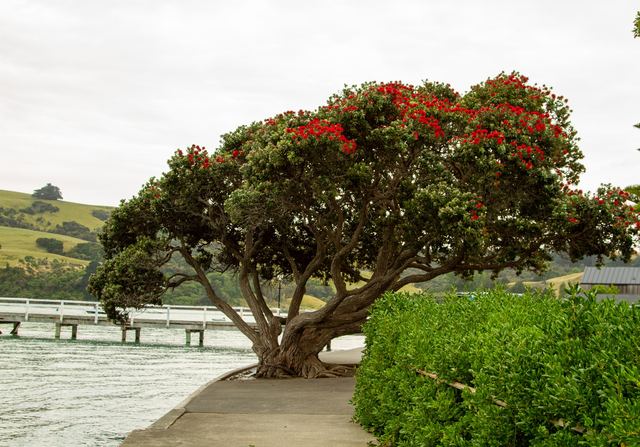
Pōhutukawa (Metrosideros excelsa) is endemic to New Zealand. NZPCN describes trees up to 20 m tall with a canopy spread of 10 to 50 m and trunks up to 2 m across, so on a suburban section it's the width that catches people out, not the height.
It grows naturally north of Poverty Bay and north Taranaki and has been planted widely elsewhere. Many trees carry 'brooms' of aerial roots hanging from the branches. NZPCN gives the flowering season as August to March, mainly November and December, which is when the red stamens carpet paths, decks and cars underneath.
It was assessed as Not Threatened nationally in 2023, but NZPCN lists its Auckland regional status as Regionally Declining.
Is your pōhutukawa protected?
Often, and you can't tell by looking. In Auckland, Schedule 10 of the Unitary Plan includes pōhutukawa among its notable trees, some of them street trees listed by road reserve. Separately, in Auckland's urban zones, altering or removing any indigenous tree over 3 m tall within 20 m of mean high water springs is a restricted discretionary activity, so even pruning a big coastal pōhutukawa can need resource consent.
Other councils have their own schedules and rules. Ask yours before you prune or remove one, and remember that a listed tree has limits on even small trimming. Our Auckland tree rules page and the notable trees guide show how to look a tree up.
Threats to watch for
- Bright yellow-orange powdery eruptions on the leaves, often underneath: possible myrtle rust.
- Chewed leaves and bare twigs: NZPCN says possum browse can seriously damage and even kill pōhutukawa.
- Cars, boats or trailers parked over the roots, which DOC lists among human threats to the tree.
- Fires lit underneath, also on DOC's list.
- Dead branches or a thinning crown on an older tree.
If you think it's myrtle rust
Leave the plant alone and don't collect samples. DOC says to photograph the rust and the plant and report it on iNaturalist. Myrtle rust spores are microscopic and travel on wind, clothing, insects and equipment, so cutting off infected growth yourself can spread it.
DOC says pōhutukawa are under potential threat from myrtle rust, and that it can't be eradicated from Aotearoa. Our kauri dieback and myrtle rust guide has more on what to look for.
What you can do, and what to leave
You can
- Snip small twigs and suckers you can reach from the ground with secateurs, once you've confirmed the tree isn't listed.
- Sweep up fallen stamens and leaves in summer.
- Keep cars, trailers and boats off the root area.
- Report suspected myrtle rust with photos rather than cutting it out.
Leave to an arborist
- Pruning any sizeable branch, or shaping the canopy.
- Limbs reaching over the roof, the road or a neighbour's section.
- Branches near power lines, which go to the lines company's approved contractor.
- Checking an old tree for decay, and the consent paperwork if it's protected.

Pōhutukawa: what to do next
We'd treat it as protected until the council told us otherwise. We'd keep vehicles off its roots, report any yellow powder on the leaves rather than cutting it off, and leave anything more than light pruning to an arborist who knows the council's limits. If the tree were crowding the house, we'd ask about thinning or lifting the crown long before talking about removal.
Want an arborist to look at it?
Tell us the job and your postcode, and a local arborist calls you to talk it through.