
Before anyone starts cutting
Keep people and cars out from under a cracked, leaning or hung-up tree, and call 111 if anyone is in danger. Never touch a power line or a branch touching one; if a line is down, stay at least 10 metres away and call 111. Within 4 m of a network line, only approved utility arborists may work, so call your lines company.
Does it need to come out, or can it be pruned?
Plenty of trees that worry people can stay. Branches on the roof, a tree shading the vege garden or limbs over the neighbour's drive are usually trimming and pruning jobs. Pruning deals with what bothers you and keeps the rest.
Removal is the honest answer when the tree is dead or dying, has a split or decay that can't be managed, is wrecking a drain, or will only outgrow its spot. Decay, dead branches and hung-up branches are hazards WorkSafe's 2012 arboriculture code lists, so photograph any for the arborist. See dead and dangerous trees.
Tree felling, or taking it down in sections?
Felling means bringing the whole tree down in one piece. It only works with open ground for it to land in: a paddock, a big back section, a shelter belt with nothing beside it.
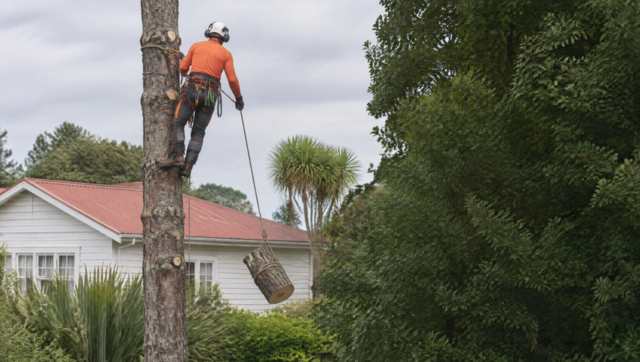
Beside a house, a fence or the neighbour's glasshouse, an arborist takes the tree apart from the top down instead, lowering each piece rather than letting it fall. Some jobs bring in a crane or a cherry picker when the tree or the access calls for one.
It's skilled, dangerous work. Graduates of the Arboriculture strand of NZQA's Level 4 horticulture services certificate (qualification 2674) can remove trees using a range of felling techniques, so ask what the crew holds.
If a crew reschedules for strong wind or rain, that's the rules working: WorkSafe's 2012 code says tree work must stop while the weather makes it dangerous.
What makes a removal a bigger or smaller job?
Size. The taller and wider the tree, the more pieces it comes down in and the more wood is left at the end.
What's underneath. Roofs, glasshouses, water tanks and gardens you want kept mean slower, more careful work than a tree in the open.
Access. A steep section, or a tree you can only reach through the neighbour's place, adds time and decides which machinery fits.
What you want left. Chipping, carting the wood away or leaving it in rounds for the fire, plus the stump, all change the job.
Kauri. Kauri dieback travels in soil, and since 2 August 2023 earthworks within a kauri hygiene zone need an earthworks risk management plan. See our kauri dieback guide.
Do you need consent to remove a tree in New Zealand?
Sometimes, and your council's district plan decides it (in Auckland, the Unitary Plan). Work on a tree the plan protects needs a resource consent, which is permission from the council under the Resource Management Act.
Since 1 January 2012, the Act has stopped blanket tree protection on urban sections, so in towns most protection sits with trees a plan lists by name: notable, scheduled or significant trees. Auckland lists its notable trees in Schedule 10, and removing one needs consent.
Plans also protect trees by where they grow. In Auckland, consent is needed to remove vegetation within 10 m of an urban stream, or a tree in a road or open space zone over 4 m tall or 400 mm in girth (the distance around the trunk).
A dead tree doesn't automatically get a pass. Christchurch wants a Tree Removal Certificate (P-024), prepared by a technician arborist, before a dead or structurally failed significant tree is felled.
New planning laws passed in September 2026, but existing RMA plans carry on during the transition, so today's district plan rules still apply. Check your council on our tree removal permits page and read about notable trees before anything is cut.
What about the stump and the wood?
Taking a tree down and getting rid of its stump are separate jobs, and plenty of quotes only cover the first. If you want the stump gone, say so at the start; stump grinding explains grinding, digging out and leaving it. Ask too whether the chips stay as mulch and the trunk is left in rounds.
What a written removal quote should cover
- How the tree comes down: felled whole, in sections, or with a crane or cherry picker
- Who checks the district plan, and who applies for any resource consent
- What gets protected on the way down: roof, fences, gardens, the neighbour's side
- The stump: ground out, dug out or left
- Public liability insurance, and the qualifications of the crew
- The clean-up, and what finished looks like
Tree removal: what you can do yourself
You can
- Find out whether the tree is listed in your district plan, and ask the council if you're not sure
- Photograph the tree, any cracks, lean or dead branches, and what's underneath it
- Prune small, low branches you can reach with both feet on the ground, using hand tools
- Tell your neighbour before work starts
Leave to an arborist
- Felling, sectional removal and anything needing a chainsaw, ropes or a ladder
- Any tree close to the house, a shed or a fence
- Leaning, split or hung-up trees, even small ones
- Trees within 4 m of a network power line (approved utility arborists only)
- Grinding or digging out the stump
Hiring an arborist for tree removal
We'd answer the consent question first, by checking the district plan or ringing the council, because it shapes everything else. Then we'd have an arborist look at the tree in person and put the quote in writing: how it comes down, what happens to the stump and the wood, and who's insured. If the tree is anywhere near a line, we'd ring the lines company before anyone else.