
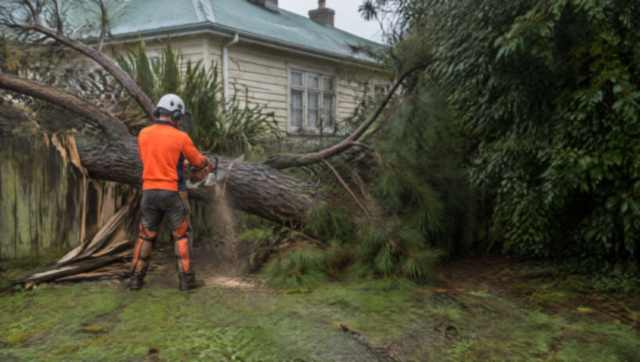
Do this first
If anyone is hurt or in danger, call 111. Keep people, pets and cars well clear of fallen trees and of hanging or split branches, which can drop without warning. Treat every power line as live, even one on the ground: if a line is down, stay at least 10 metres away, call 111, and never touch it or a tree touching it. Report damaged lines to your lines company.
Once everyone is safe
Look from a distance
Auckland Emergency Management advises care around trees that may have been damaged by high winds. Look for cracks, lifted soil at the base and branches caught in other branches, without going underneath.
Call the right people
A tree on a power line: your lines company. A tree on the street or in a park: the council. A tree on your section or over the fence: an arborist.
Photograph everything
The Natural Hazards Commission asks people to take photos only when it's safe, and before anything is repaired, moved or thrown away. Get the tree, where it fell, and everything it hit.
Tell your insurer
Report the damage to your insurer as soon as you can, or to your landlord if you rent, and keep a record of what happened and when.
Who to call about a tree on a power line
A tree on a network line is the lines company's job, not an arborist's. Your power retailer is the company you pay the bill to; your lines company runs the local network and handles outages on it.
Some of the larger lines companies: Vector, Wellington Electricity (Wellington, the Hutt Valley and Porirua), Powerco, Unison (Hastings, Napier, Taupō and Rotorua), Orion (central Canterbury) and Aurora Energy. For anywhere else, Electricity Networks Aotearoa's lines company map shows yours for any address.
A fallen service line to your house is just as live: stay back and call 111. Service lines are the property owner's responsibility, so tell your insurer too.
What an arborist does after a storm
The first visit is usually about making the tree safe, not tidying the garden. WorkSafe's 2012 arboriculture code says that in emergency situations, work should be the minimum needed to make the situation safe, so hanging branches and anything resting on the house come first.
The same code says tree work must be suspended while high winds, wet weather or poor visibility make it dangerous, so a crew may wait for the weather to ease before going near a damaged tree. After a big storm arborists are stretched everywhere, and nobody can promise a time.
Storm-broken trees hold wood under tension and lean on each other, so that's work for a trained crew, never a homeowner job.
Does insurance cover a fallen tree?
Partly, and it depends on what the tree hit. The Insurance Council of New Zealand says house policies generally cover damage a fallen tree causes to insured structures, such as the house, garage or fences, along with removing the parts of the tree that caused it.
The tree itself generally isn't covered, and nor is removing the rest of it still in the ground. If a storm-felled tree hasn't damaged an insured structure, there's unlikely to be cover for removing it. Some policies carry a landscaping or tree removal benefit with limits, so read your wording and ask your insurer.
Do storm-damaged protected trees still need consent?
They can, because making a tree safe and taking the whole tree out aren't the same thing. In Auckland, a notable tree comes off Schedule 10 only after it has been removed through a consent or emergency works and the council has given the owners written notice.
If a storm leaves a Christchurch significant tree structurally failed, the council still wants a Tree Removal Certificate (P-024) from a council-listed technician arborist before it's felled.
So tell the arborist if the tree might be protected, and talk to the council before anything beyond making it safe. Our tree removal permits page links to each council.
Storm damage: what you can do yourself
You can
- Call 111 if anyone is hurt or in danger
- Photograph the damage from a safe distance before anything is moved
- Call your insurer, or your landlord if you rent
Leave to an arborist
- Anything hanging, split, leaning or resting on the house
- Trees under tension, uprooted or tangled with other trees
- Cutting up fallen trunks and big branches

Hiring an arborist for storm damage
We'd get everyone clear, ring 111 if anyone was in danger and the lines company if a line was involved, then take photos before touching anything. Next call, the insurer. Then we'd ask an arborist to make the tree safe first and quote the rest separately, so it's clear to the insurer which part was urgent.