
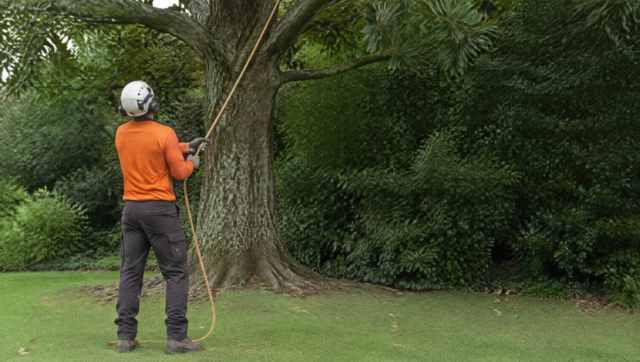
Trees and power lines in Rotorua
Call 111 if anyone is in danger. Unison runs Rotorua's lines: stay at least 10 metres from a fallen line and ring Unison. When it's safe, take photos for your insurer before anything is moved, and leave split or hanging limbs for an arborist.
Council tree rules in Rotorua
The District Plan's Notable Trees chapter, updated in September 2026, protects scheduled trees on public and private land. The schedule includes a ginkgo in Government Gardens planted around 1892, a coast redwood grove on Long Mile Road planted in 1901, a stand of 15 kahikatea on Curtis Road, and the Scion campus Cryptomeria, the largest of their kind in New Zealand. Some sit on ordinary home addresses, like a pōhutukawa on Kāwaha Point Road and a Japanese maple in Vista Place.
The rules are tight. Trimming or maintenance is permitted only when a qualified arboriculturist does it and council approves it before work starts. Removal is permitted only when a qualified arboriculturist confirms the tree is dead or dangerous and council signs that off first; other removals not provided for are non-complying. Building or earthworks within the dripline (the ground under the outer edge of the canopy) is discretionary, so it needs a resource consent too.
Emergency work to protect life or property is carried out by council or a utility operator, who then report it to council in writing. Our permits guide explains district plan protection in general, and Rotorua Lakes Council can help.
Tree removal in Rotorua: what's local
Redwood country
Tītokorangi and Whakarewarewa Forest, The Redwoods, is five minutes' drive from the city centre and famous for its towering Californian redwoods. Redwoods turn up on the notable list too, including the 1901 Long Mile Road grove and a tree at Hamurana Lakeshore Reserve.
Geothermal ground
Rotorua has over 110 urban park reserves, among them Kuirau Park with its mud pools and boiling lakes. The District Plan sets building setbacks from geothermal surface features and bores, and the Geothermal Bylaw requires bores to stay reachable for a drilling rig. If your section has a bore or warm ground, tell the arborist before any machine comes in.
After the January rain
A state of emergency was declared across the Bay of Plenty on 21 January 2026 after extreme rain. After a storm like that, look for big trees that have taken on a new lean or have soil lifting at the base.
Unison's lines
Unison serves Rotorua, Taupō, Napier and Hastings. It says your local arborist may also be approved to work near its lines, and that the private service line to your house is yours to keep clear; for trimming near one, you can ask Unison for a safety disconnection, with conditions.
Stump grinding in Rotorua
Unison sends a First Cut or Trim Notice, or a Cut or Trim Notice, when a tree grows too close to its network lines. Ignoring one in time can mean a fine of up to $10,000, plus $500 a day until the work is done, so pass any notice to your arborist straight away. Trees and power lines explains the zones.
Stumps get their own page, stump grinding in Rotorua, because Rotorua adds geothermal bores and a lines company outside beforeUdig to the usual checks.
If you'd like a tree smaller rather than gone, ask for a crown reduction. Topping (cutting the top off to stubs) grows back as a tangle of weakly attached shoots, and an arborist will usually talk you out of it; see lopping vs pruning.

Hiring an arborist in Rotorua
Look the address up on the Notable Trees Schedule first; if the tree is on it, nothing happens until council has approved it. Mention any bore or geothermal feature on the section to the arborist up front. For anything near Unison's lines, ring Unison before you ring anyone else. Then get the plan, the stump and the clean-up written into the quote.