
Before anyone digs or grinds
Cables and pipes can run anywhere under a section. Lodge an enquiry with beforeUdig, the online service for utility plans, and don't start until the plans arrive, generally within two business days. Some asset owners, including Unison, Centralines, Eastland Network and Kāpiti Coast District Council, aren't members, so contact them directly. Private pipes on your own section may not be on any of those plans.
Roots in drains
Roots rarely break into a sound pipe. They find a crack or a loose joint, then thrive on the water inside. Clearing them out is a drainlayer's job; stopping them coming back means fixing the pipe, and sometimes cutting back or removing the tree.
If the roots come from next door, talk to your neighbour first. Community Law says you can cut back the parts of a neighbour's tree that encroach on your property, as far as the boundary, and that if encroaching roots damage your property you can claim for their removal and repairs in the Disputes Tribunal or District Court. See your neighbour's tree.
Roots under paths, driveways and the house
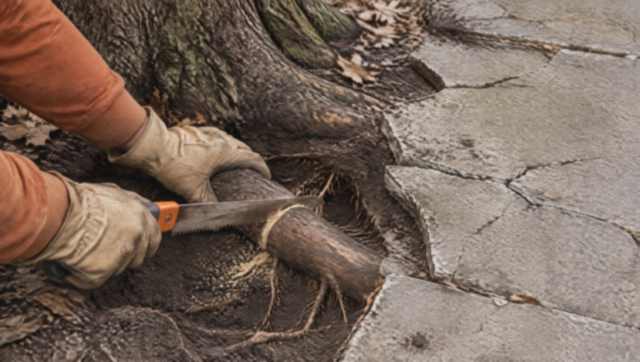
Surface roots lift pavers, paths and driveways as they thicken. The fix might be cutting one root and relaying the path, bridging over it, or moving the path.
Cracks in the house are a different question. Get an engineer to look at the building as well as an arborist at the tree, because roots aren't always the cause. Our guide to tree roots and your house goes further.
What cutting roots does to the tree
Big roots near the trunk hold the tree up, and the fine roots further out take up its water. Cut too many, or too close to the trunk, and a tree can decline over a few years or become unstable in wind. That's why an arborist should decide which roots can go. Sometimes the answer is a root barrier or a narrower trench; sometimes it's better to remove the tree and grind the stump.
On a protected tree, root work can need consent. Auckland's notable tree rules cover the protected root zone, and Dunedin's 2015 proposals needed consent for earthworks within a scheduled tree's drip-line (the ground under the canopy's outer edge). Check tree removal consents first.
Near a kauri, earthworks within its hygiene zone have needed an earthworks risk management plan since 2 August 2023. It isn't settled whether root cutting counts, so raise it with Tiakina Kauri before work starts.
Tree root removal: what you can do yourself
You can
- Lodge a beforeUdig enquiry and wait for the plans.
- Photograph cracks, lifted paths and blockages, with dates.
- Have a drainlayer camera the drain to see where roots get in.
- Talk to your neighbour if the roots come from their tree.
Leave to an arborist
- Deciding which roots can be cut without risking the tree's stability.
- Root pruning, root barriers and root grinding.
- Removing the tree and grinding the stump and main roots.
- Root work near protected trees, under any consent.

Hiring an arborist for tree roots
We'd find out where the roots are actually getting in before cutting anything: a drain camera for pipes, a careful look under a lifted path. Then we'd have an arborist mark which roots can go. Cutting first and asking later is how a healthy tree turns into a leaning one.