
Before you prune anything yourself
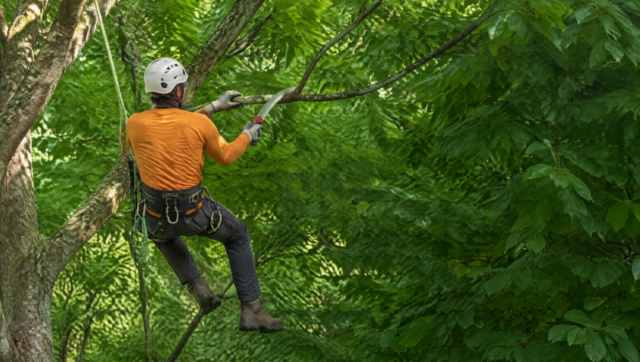
Stay on the ground: if a branch needs a ladder, a climb or a chainsaw to reach, it's an arborist's job. Don't prune any tree that's within 4 m of a network power line. Only qualified and approved utility arborists may trim that close, and owners may trim only when every part of the tree is at least 4 m away, so ring your lines company instead.
Trimming or pruning: is there a difference?
Not really. Tree trimming is the more common search here, pruning is the word arborists tend to write on the quote, and both mean cutting selected branches to shape, clear or tidy a tree.
What matters is which branches come off and where each cut is made. A cut just outside the collar, the slight swelling where a branch joins the trunk, lets the tree seal the wound. Flush cuts and ragged stubs give decay a way in.
What kinds of pruning are there?
Canopy lifting. Taking off the lowest branches so you can walk, mow or park underneath, or let light into the garden. Done in stages, it leaves the tree balanced.
Thinning. Removing selected branches through the crown so more light and wind pass through. It brightens a shaded lawn and lightens a dense tree in an exposed spot.
Deadwood removal. Cutting out dead branches still on the tree before they fall. Auckland Emergency Management suggests removing diseased or damaged branches to help trees stand up to wind.
Clearing the roof and gutters. Shortening branches back to a side branch so they stop scraping the roof, filling the gutters or hanging over the drive.
Opening a view. Thinning or lifting part of a crown so you can see past it. Ask what the tree will look like afterwards, because a view cut too hard grows back thicker.
Reducing the crown. Shortening the crown (the leafy top) by cutting branches back to smaller side branches, which keeps the tree's natural shape at a smaller size.
Is tree topping the same as trimming?
No, though plenty of people ask for it, and lopping means much the same thing. Topping cuts the top or the main branches back to stubs, whatever their size, to make a tree shorter in one go.
It looks tidy for a season. Then each stub pushes out a cluster of fast, weakly attached shoots, and the big cut ends are slow to close and prone to rot. Within a few years the tree is often as tall as before, denser, and more likely to drop branches.
If height is the worry, ask for a crown reduction back to side branches, or ask whether the tree is simply too big for its spot. Our lopping vs pruning guide goes further.
Can you prune a protected tree?
Often, within limits your district plan sets. In Auckland, trimming a notable tree stays within the rules only if no branch over 50 mm is cut, no more than 10 per cent of live growth comes off in a calendar year, and the work meets best arboricultural practice. Anything beyond that needs resource consent.
Deadwood is treated differently there: removing dead wood from an Auckland notable tree is permitted when a qualified arborist does it, and needs consent when anyone else does.
Christchurch's District Plan sets out the pruning it allows on significant trees, and some of it may only be done by, or on the advice of, a works arborist competent to the NZQA Level 4 arboriculture standard. Other councils set their own limits, so check yours on our tree removal permits page first.
When should a tree be pruned?
It depends on the species, and there's no single New Zealand calendar for it, so ask the arborist. Dead, broken or rubbing branches are worth dealing with when you notice them, and the Insurance Council suggests checking trees before and after severe weather.
If you love a pōhutukawa's flowers, which come mainly in November and December, talk about timing before booking. Myrtle rust can travel on contaminated clothing and equipment, so clean tools matter around pōhutukawa and other natives in the myrtle family. Fruit trees have their own season: see fruit tree pruning.
Questions to ask before the pruning starts
- Which branches are coming off, and roughly how much of the crown?
- Will each cut go back to the trunk or a side branch, or leave a stub?
- Is the tree on the council's notable or significant list, and who checks?
- Do you prune to a recognised standard? NZ Arb supports international ones such as BS 3998:2010.
- Will anything partly cut or hung up be left in the tree when you finish? WorkSafe's 2012 code says it shouldn't be.
- Are your tools and boots cleaned between jobs, especially near kauri or pōhutukawa?
Tree pruning: what you can do yourself
You can
- Small branches you can reach with both feet on the ground, using secateurs, loppers or a pruning saw
- Suckers and water shoots growing from the base of the trunk
- Dead twigs on young trees and shrubs
- Raking up and bagging the clippings
- Photographing the tree before and after, so you can compare
Leave to an arborist
- Anything needing a ladder, a climb or a chainsaw
- Branches over the roof, the drive or the neighbour's place
- Crown lifting, thinning or reduction on a mature tree
- Notable or scheduled trees, within your council's rules
- Any tree within 4 m of a network power line (approved utility arborists only)
Hiring an arborist for tree pruning
We'd name the one thing the tree is doing that bothers you, whether that's the gutters, the shade or the view, and ask the arborist for the smallest prune that fixes it. That's usually lifting or thinning rather than taking height off. If the tree might be on a notable list, we'd get the council's answer before anyone books a date.