
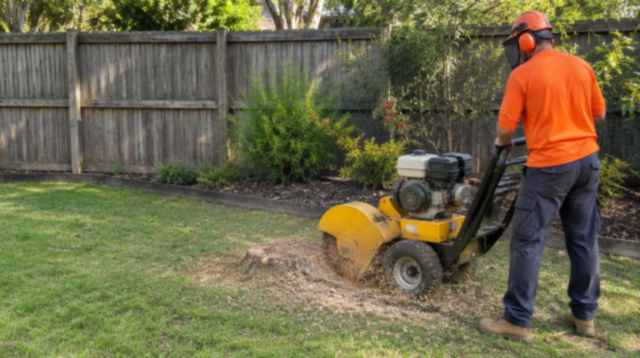
How stump grinding works in Wellington
Much of Wellington is built on steep ground, with plenty of suburbs perched well above the city. A stump at the top of forty steps, or behind the house down a narrow path, is a different job from one beside the driveway.
Grinders come in sizes. A big machine is quick but needs room and a firm path; a small one fits through a gate but takes longer on a large stump. That's why an arborist will usually ask for photos of the route, or come and look, before they quote.
Before stump grinding starts in Wellington
Roots wrap around pipes and cables, and a grinder cuts below the surface. Ask your arborist to lodge a beforeUdig enquiry, the online service that shows where cables, pipes and other utility assets are; plans generally arrive within two business days, and work shouldn't start until they do. Your own drains, water pipe, irrigation and any cable to a shed won't always show up, so point out everything you know about.
Stump grinding in Wellington: what's local
Trees the wind pushed over
After a storm like June 2013, when trees came down across the region, the stump is often half out of the ground with a root plate attached. An arborist will usually cut it back and grind what's left, and soil may need putting back where the roots lifted it.
Stumps on banks
On a steep bank a stump can be holding soil. Grinding it out and leaving bare ground can let the bank slump in heavy rain, so ask whether it's better cut low and left, or ground with new planting straight after.
Berm and Town Belt stumps
Wellington Electricity says road reserve trees are handled by the local council, or by NZ Transport Agency Waka Kotahi on highways, and the Town Belt is owned by Wellington City Council. If the stump is on the berm or the Belt side of your fence, report it rather than booking a grinder.
Species that sprout again
Some fast growers, sycamore among them, can send up shoots from a cut stump. Grinding below the surface, or treating regrowth early, saves you a thicket in a year or two.
Grind it, or leave it?
| Grind it out | Cut low and leave it | |
|---|---|---|
| Where you can plant | Close by once the chips are cleared and soil added | Around it, not on it |
| On a steep bank | Roots stop holding the soil as they rot | Keeps holding the soil for a while |
| Regrowth | Usually stops it | Vigorous species may resprout |
| Access needed | A path the machine can get along | Hand tools only |
Stump grinding in Wellington: what you can do yourself
You can
- Clear pots, stones and rubbish from around the stump
- Mark any pipes, irrigation or garden lighting you know about
- Photograph the route from the street to the stump, including steps and gates
- Fill the hole with soil once the chips are cleared
Leave to an arborist
- The grinding itself, and lifting surface roots
- Stumps next to retaining walls, foundations or paths
- Deciding whether a stump on a bank should stay
- Felling the tree first, if it's still standing
Questions to ask about stump grinding in Wellington
- How deep below the surface they'll grind
- Whether surface roots are included
- The route in, and any hand-carrying of the machine
- Whether the chips are taken away or left as mulch
- That services have been checked first
- What happens if they hit a pipe or a buried rock

Hiring an arborist for stump grinding in Wellington
Walk the route from the street to the stump and photograph every step, gate and tight corner, then send those photos with the job. If the tree is still standing, removal comes first, and the Wellington permit page applies before anything is cut.