
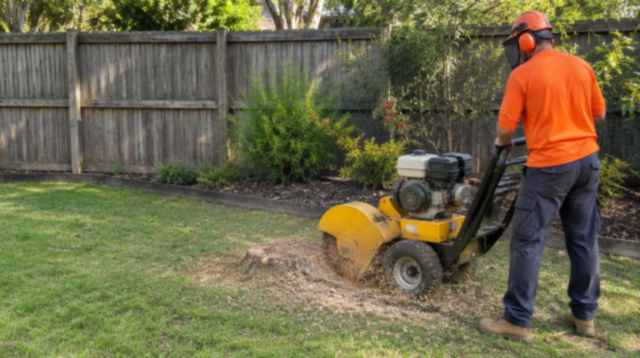
Before stump grinding starts in Hamilton
A grinder works below the lawn, where power, water and data lines run. WEL Networks says to check cable locations through beforeUdig before any excavation, treats its own markings as approximate, and needs a Close Approach Consent for work within 2 metres of its cables. WorkSafe's arboriculture code also names stump removal as work to notify to the owner of any underground service it may affect. A careful arborist sorts this out before the day, not on it.
How stump grinding works in Hamilton
Grinding takes the stump down below the surface and leaves a mound of chip mixed with soil. The hole settles as the remaining roots rot, so topping it up later is normal. If you want to replant in the same spot or run a path over it, say so, and ask how deep they'll go.
Hamilton City Council doesn't remove tree debris from private property, so the chip is yours unless the quote says otherwise. It makes reasonable mulch on garden beds away from the house. Agree whether the arborist spreads it, leaves it in a pile or takes it away, and get that in writing.
Stump grinding in Hamilton: what's local
On a gully bank
Half of Hamilton's gully land is privately owned, and council lists erosion along the gullies among the effects of drought. A felled tree's roots keep holding soil for a while, so on a steep bank an arborist may suggest cutting the stump low and leaving it. Gullies are Significant Natural Areas with their own District Plan rules, so ask council before disturbing one.
Next to a protected tree
Hamilton's protected heritage trees are mostly in older neighbourhoods, particularly Hamilton East and Claudelands. If a stump sits close to one, check with council before grinding: work on a protected tree on private land will probably need a resource consent, and its roots may run right under yours.
On the berm
A stump on the grass verge is usually what's left of a council street tree. Council asks that nobody prunes or removes a street tree without its permission, so ring the council instead of adding it to your own job.
Old macrocarpa shelter
Where an old macrocarpa hedge or shelter tree has come out, the stump won't resprout, but the NZ Farm Forestry Association says macrocarpa roots are slow to decay. Grinding speeds that up where you want to mow, plant or build.
Stump grinding in Hamilton: what you can do yourself
You can
- Mark sprinklers, garden lighting and anything else buried near the stump before the arborist arrives.
- Lodge a beforeUdig enquiry early, or check that the arborist has.
- Clear pots, toys and loose stones from around the stump.
- Keep children and pets inside while the machine runs, because flying chip travels.
Leave to an arborist
- Running the grinder, which NZ Arb's guide says must never be left unattended while it's running.
- Hand digging to expose cables where the markings come close to the stump.
- Judging whether a stump on a gully bank should stay.
- Chasing out big surface roots heading for paths or the house.
Questions to ask about stump grinding in Hamilton
- Each stump, roughly how wide, and how far below ground it will be ground
- Who lodges the beforeUdig enquiry and deals with any WEL Close Approach Consent
- Whether surface roots are included
- What happens to the chip: left in a pile, spread, or taken away
- Access: gate width, slopes and how the lawn will be protected
- Proof of public liability insurance

Hiring an arborist for stump grinding in Hamilton
We'd get the cable plans before anything else, then decide stump by stump. On a flat lawn, grind it out and backfill. On a gully bank, ask the arborist whether the stump is doing more good holding the soil. And if it's on the berm, it's council's call, not yours.